Rust - Emergent Player Interaction Through Scarcity and Space
Written by Matthew Bartlett on June 25, 2026
Released into early access by Facepunch Studios in 2013 and fully launched in 2018, Rust is a multiplayer survival game that has no inherent story, objective or quests. Every player spawns onto the same map with nothing but a rock and a torch. This lack of structure is deliberate. Studio founder Garry Newman has described the design intent as giving players tools rather than goals, trusting that meaningful experiences will arise from their interactions rather than from anything the developers script (PC Gamer, 2014). This essay argues that resource scarcity and spatial design are two core mechanics game designers use to engineer the conditions to guarantee players will meet, while the social outcomes of those meetings remain entirely emergent and player authored. Using Hunicke, LeBlanc and Zubek’s (2004) MDA framework to separate the game’s rules from the behaviours and feelings they produce, it examines how effectively this systems driven approach generates meaningful social experience without the support of authored narrative.
In MDA terms, resource scarcity is one of Rust’s foundational mechanics, and the dynamics that define the early to mid game flow directly from it. High-value loot does not spawn freely. It is concentrated at finite locations that reset on a timer, which means progression is impossible for a player who stays in one place. The result is a tiered ladder of risk. Basic materials such as wood, stone and cloth can be gathered safely in forested areas. Metal components and high-tier equipment a player needs to remain competitive are found only in exposed zones, alongside roads or within the monuments scattered across the map. Each rung of this ladder trades safety for reward, pushing the player closer and closer to others competing for the same supply. This is the same design logic that Kramarzewski and De Nucci (2018) identify when they argue that limited resources compel players into difficult choices and creative solutions rather than dictated ones. Scarcity in Rust does not tell the player what to do, it removes the option of doing nothing. The mechanic is fixed and impersonal, but it generates a dynamic of constant movement into contested spaces escalating in danger. This is the precondition for every social encounter the game produces. Before any player has spoken to another, the economy of the map has already decided that they will eventually meet.
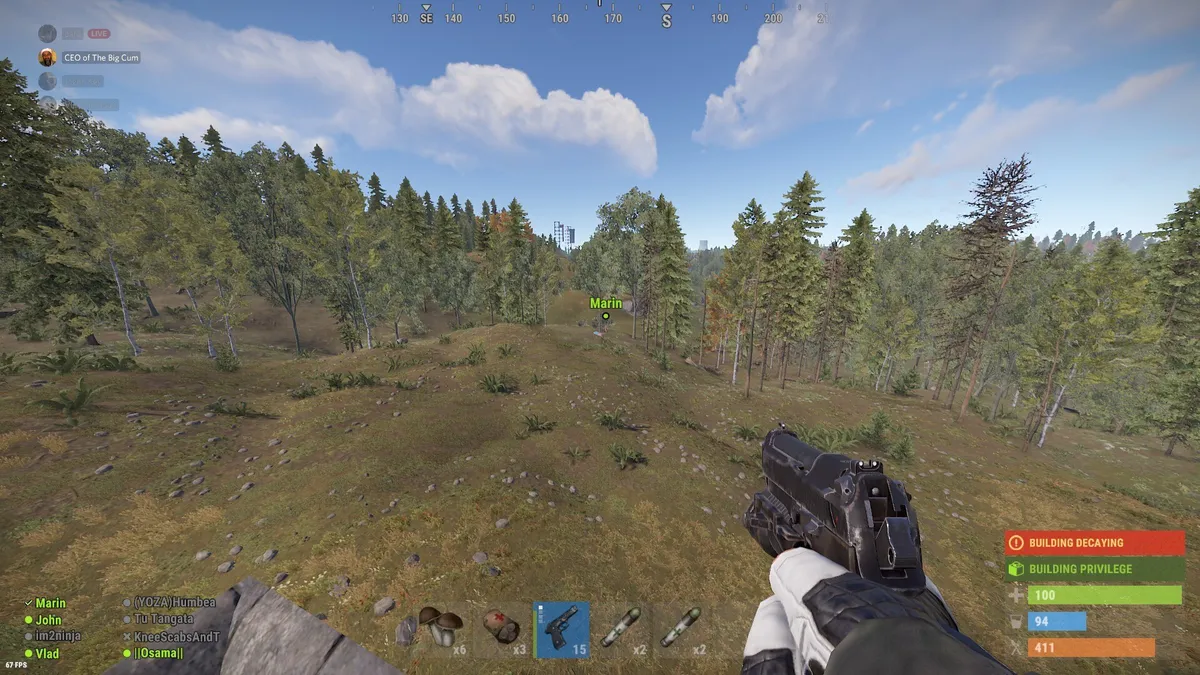
If scarcity sets players in motion, spatial design determines where that motion leads. Monuments are not just loot spawn locations; they function as funnelling devices that guarantee convergence. They are finite, fixed and connected by a road network that concentrates traffic. Building beside a road grants logistical advantages but increases exposure, while the tiered structure of the monuments themselves continually draws players toward the most dangerous shared spaces as they progress. Juul (2005) distinguishes games of progression, in which the player advances through a predefined sequence of authored challenges, from games of emergence, in which a small set of interacting rules produces a vast and unplanned possibility space. Rust sits almost entirely at the emergent end of this spectrum. Where a progression driven survival game would script encounters as set pieces, Rust scripts only the geography and lets the encounters write themselves. Dormans (2012) gives this approach its name, arguing that designers can engineer emergence by building the systemic conditions under which complex, unforeseen behaviour reliably arises without being individually authored. Rust’s monuments are exactly this kind of engineering. Facepunch cannot determine whether two players who meet at a monument will fight, trade or ally. But the spatial system guarantees that the meeting happens. The designer authors the stage and its pressures; the drama that unfolds upon it remains outside their control. This is the mechanism by which a game with no narrative reliably produces narrative-like events.
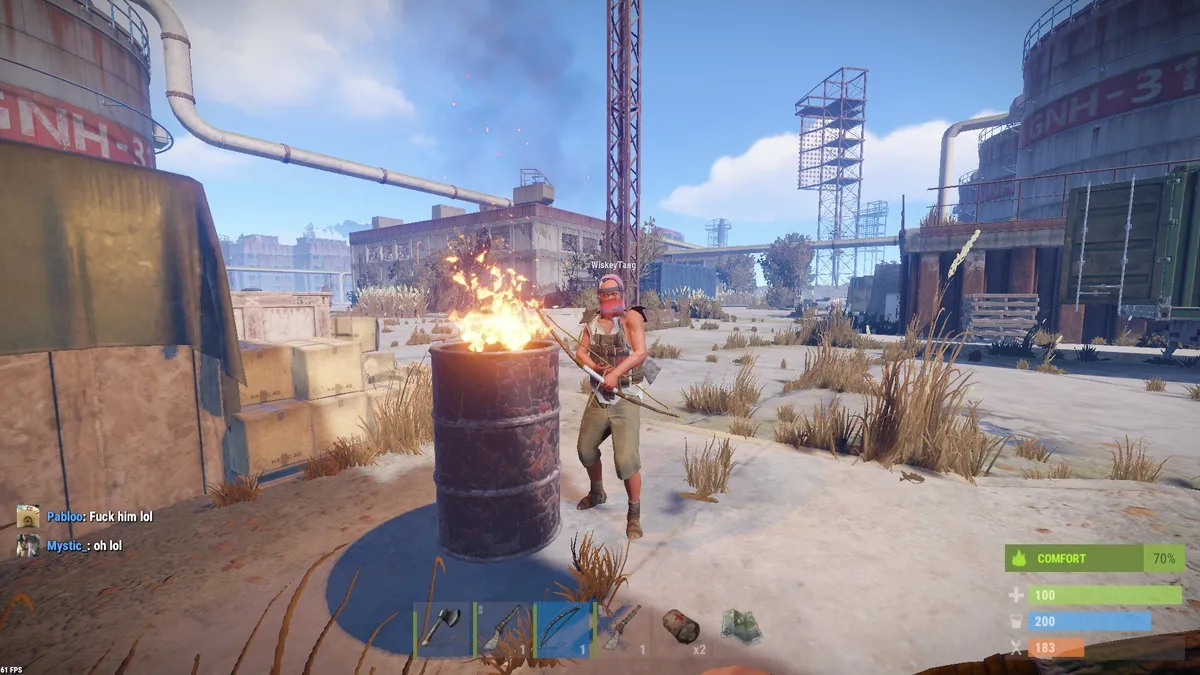
The encounters this design produces are not limited to combat, and this is where Rust’s achievement becomes clearest. The same scarcity that drives conflict also makes cooperation valuable. Sharing resources, coordinating defence, and trading surplus are all rational responses to a hostile economy. The result is a full social spectrum of conflict, trade, diplomacy, alliance and betrayal. None of it was authored by the developers. Ferreira et al. (2017) frame this as the defining quality of emergence in game design, in which the interaction of simple systems produces behaviour that is greater than, and different from, the sum of the underlying rules. Rust’s social order is emergent in exactly this same sense. It is a property of how the players respond to scarcity, not a feature any designer placed in the game. Betrayal illustrates this most sharply. Because trade requires proximity and exposes Information such as the location of a base, or the tier of a player’s loot, each cooperative act also creates the opportunity for exploitation. Scarcity does not merely permit betrayal. It actively incentivises it, since the neighbour one trades with today is also the most informed potential raider tomorrow. The trust that makes cooperation possible is the same trust that makes betrayal profitable. In MDA terms, this is the aesthetic layer of Rust: tension, camaraderie, suspicion and triumph, generated entirely by dynamics rather than authored as content. The feelings are real, but no designer wrote them.
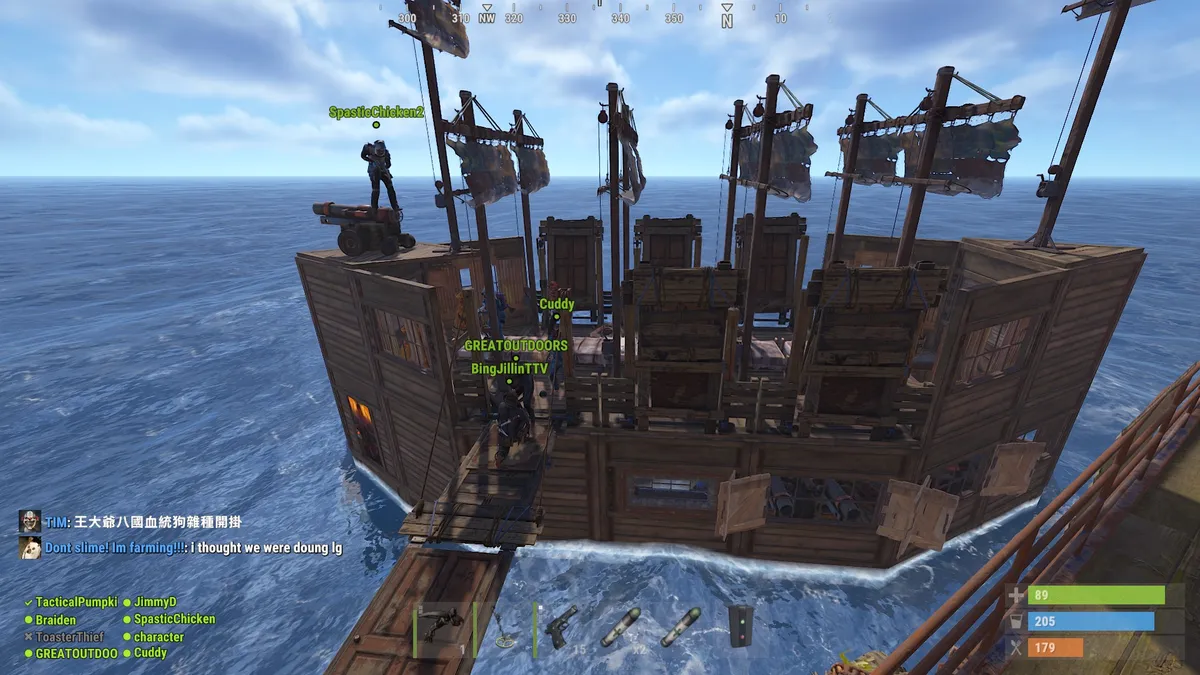
This dynamic became most vivid to me during a single playthrough. Spawning into a harsh snow biome with almost nothing, the survival conditions were punishing and I knew I had to move. I built a boat and loaded what little I had gathered and set out to find more viable ground. When the boat needed repairs partway through the journey, I stopped at an unfamiliar shoreline that looked safe enough. I was approached not with hostility but with an offer: a nearby player invited me to build alongside him. The alliance that followed was never prompted by the game. Its value became clear a day later, when an opposing group of players began raiding his base and I was able to defend from an unsuspected angle, turning the battle in favour of my team and preserving the loot inside my ally’s base. Nothing in this sequence was authored. Scarcity had forced me out of the snow and onto that shoreline, and spatial proximity had placed two strangers within reach of one another. The trust, mutual defence and the loyalty that resulted were entirely our own. It is an experience I have struggled to find an equivalent for in more conventionally structured games.
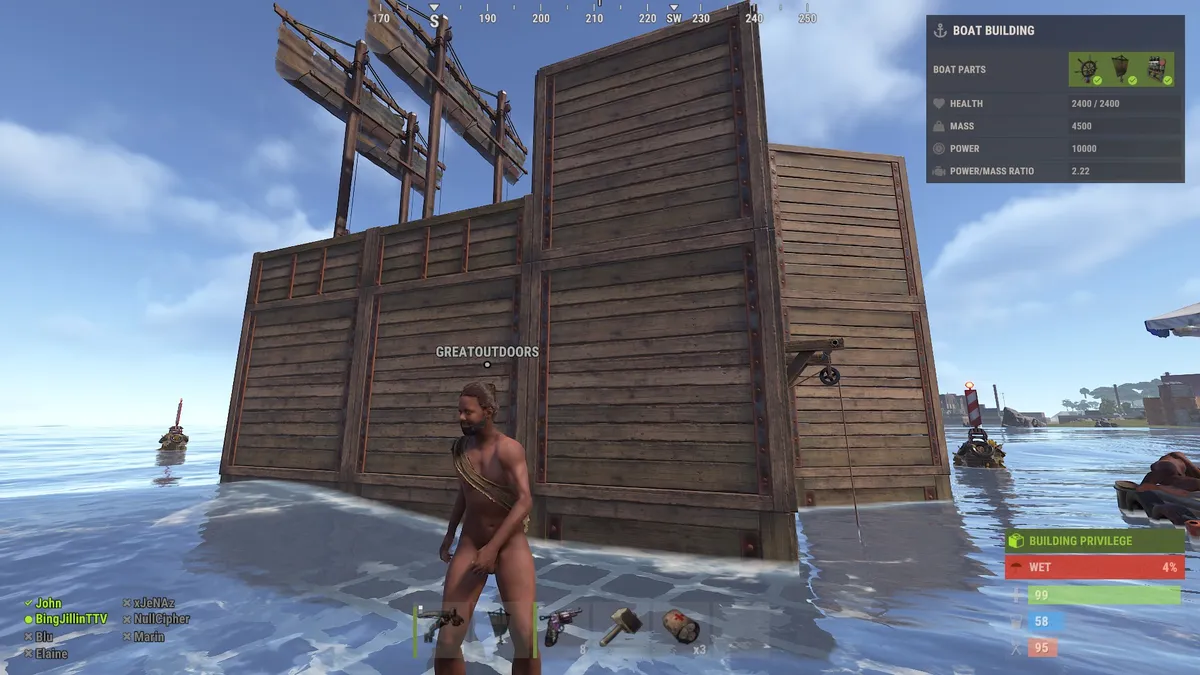
Rust demonstrates that emergent social experience can be engineered without being scripted. Scarcity and spatial design do not dictate what players do, they act as a spatial funnel and then step back, leaving conflict, trade, alliance and betrayal to arise from the players themselves. This is the source of the game’s effectiveness. No narrative designer authored the alliance formed at a broken down boat or the betrayal of a trusted neighbour. These unscripted moments carry considerable weight precisely because the player knows the experience is unique to them. It was allowed to happen rather than scripted into existence. The MDA framework clarifies why: Rust invests almost entirely in mechanics and trusts dynamics to generate aesthetics, rather than authoring the aesthetic experience directly. The result is a game that functions less as a story and more as a stage. Facepunch builds the conditions, enforces the scarcity, and positions the monuments. The players write the drama. In doing so, Rust makes a persuasive case that some of the most meaningful experiences in games are the ones designers do not write.
Dormans, J. (2012). Engineering emergence: Applied theory for game design [Doctoral dissertation, University of Amsterdam]. https://eprints.illc.uva.nl/id/eprint/2118/
Facepunch Studios. (2013). Rust [Video game]. Facepunch Studios. https://store.steampowered.com/app/252490/Rust/
Ferreira, N., Trovo, P., & Nesteriuk, S. (2017). Emergence in game design: Theoretical aspects and project’s potentialities. In N. Streitz & P. Markopoulos (Eds.), Distributed, ambient and pervasive interactions (Lecture Notes in omputer Science, Vol. 10291, pp. 142–153). Springer. https://doi.org/10.1007/978-3-319-58697-7_45
Hunicke, R., LeBlanc, M., & Zubek, R. (2004). MDA: A formal approach to game design and game research. In D. Fu & J. Orkin Eds.), Proceedings of the AAAI Workshop on Challenges in Game AI (Vol. 4). AAAI Press.
Juul, J. (2005). Half-real: Video games between real rules and fictional worlds. MIT Press.
Kramarzewski, A., & De Nucci, E. (2018). Practical game design. Packt Publishing.
PC Gamer. (2014, January 8). Garry Newman interview: On Rust and player freedom “we give them the tools, they make the world.” https://www.pcgamer.com/rust-interview/